Rothiemurchus – Ràt Murchais, ‘the
fort of Murchas’. Since the Rev. Patrick Grant in the Statistical
Account of 1791 stated that the name signified ‘the great plane
of the fir’, most people have accepted this meaning. The phonetics
of the name however, do not support this interpretation and it is
much more likely that the name means ‘the fort of Murchas’
(Watson 1926:517). The fort referred to is probably the structure
that used to stand on the hillock behind the Doune
House.
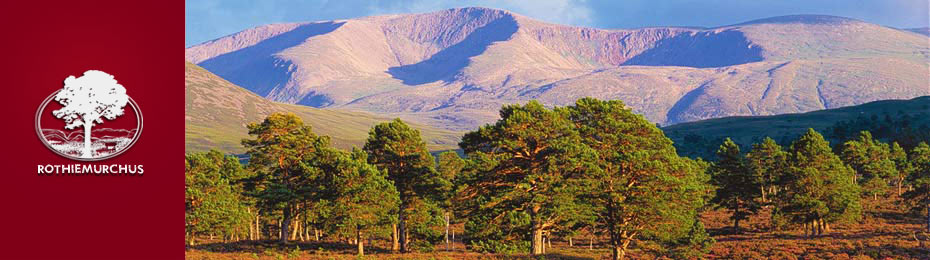
The Cairngorms – Am
Monadh Ruadh, ‘the russet coloured mountain range’.
Being made of pink Granite the mountains often appear russet red
in the setting sun.
Loch an Eilein – ‘the
loch of the island’
Gleann Einich – Gleann
Eanaich, ‘the glenn of the bog’. An apt description
as much of the bottom of this glen is covered by peat bog.
The Lairig Ghru – Làirig
Dhrù, ‘the pass of the (river) Druie’
Braeriach – Am
Bràigh Riabhach, ‘the grey brown speckled upland’
Càrn Eilrig – Càrn
Eilerig, ‘the cairn of the deer trap’
Loch Pityoulish – Loch
Peit Gheollais, ‘the loch of the settlement of the
bright place’. Peit is a word of Pictish which originally
meant ‘portion of land’ but eventually came to signify
‘open settlement’. It is common in placenames throughout
the north of Scotland. In districts where Gaelic is still spoken,
this Pictish element in these place names has been replaced by the
Gaelic one.
Tullochgrue – Tulach
Dhrù, ‘the wooded hill of Druie’
Lochan Deo – ‘sparkling
Loch’
Loch Gamhna – ‘Loch
of the stirks (young cattle)’
Coylum – ‘narrow
leap’
Luineag – ‘dancing
bubbling stream’
Beanaidh – ‘of the
washerwoman’
Druidh – ‘oozing
soaking |